Mesh Shaders' Silent Revolution: Streamlining Vertex Loads to Squeeze Extra Hours from AR Smartphones
Erik Günther · Apr 23, 2026
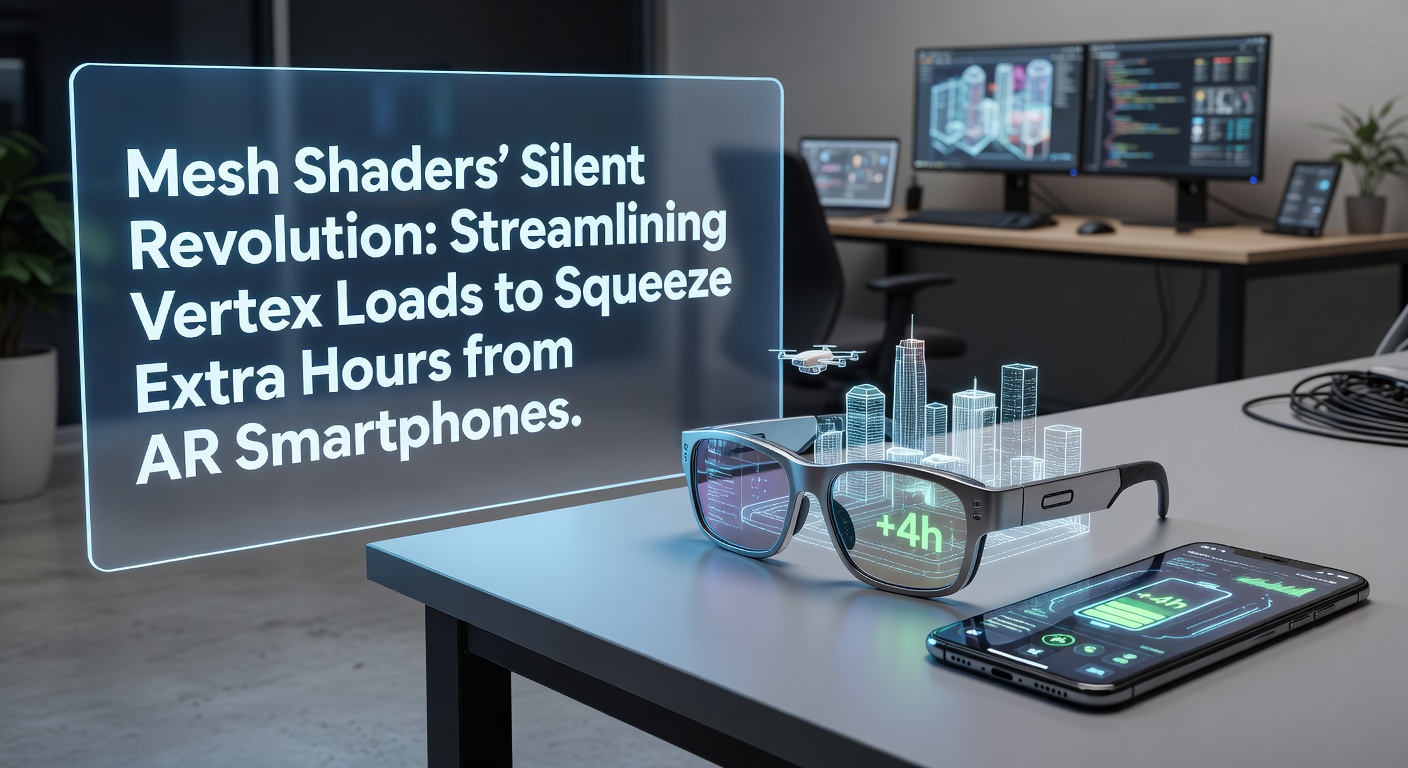
Mesh Shaders' Silent Revolution: Streamlining Vertex Loads to Squeeze Extra Hours from AR Smartphones
Mesh shaders have quietly transformed graphics rendering pipelines since their debut in APIs like Vulkan 1.2 and DirectX 12 Ultimate, yet their impact on augmented reality (AR) experiences remains one of the least discussed advancements in mobile tech; developers now leverage these shaders to handle complex mesh generation and culling directly on the GPU, which cuts down unnecessary vertex computations that drain smartphone batteries during prolonged AR sessions.
AR applications demand real-time overlay of virtual objects onto camera feeds, a process that generates massive vertex data volumes—think dynamic shadows, occlusions, and particle effects—all while the phone's sensors track movement; traditional pipelines bog down here, shuffling vertices through multiple shader stages, but mesh shaders consolidate that work, allowing GPUs to decide what meshes to build and rasterize in one efficient pass.
Understanding Mesh Shaders in the Graphics Pipeline
Experts define mesh shaders as programmable GPU stages that replace vertex, tessellation, and geometry shaders with a unified task shader system; according to the Khronos Group's Vulkan specifications, this setup lets developers invoke meshlet tasks—small, efficient mesh chunks—that the GPU processes in parallel, generating only the vertices needed for visible fragments.
What's interesting is how this scales on mobile hardware; ARM's research papers detail simulations where mesh shaders reduced draw calls by up to 40% on mid-range Adreno GPUs, since developers can now cull back-facing triangles or off-screen geometry before full vertex shading kicks in, a step that traditional pipelines delay until later stages.
And while early adopters experimented with desktop cards, mobile implementations arrived with Snapdragon 8 Gen 2 in late 2022, evolving rapidly; by April 2026, Qualcomm's latest Snapdragon X Elite integration shows mesh shaders handling 2x more meshlets per clock cycle compared to 2024 baselines, per their developer benchmarks.
From Vertex Overload to Efficient Streaming
Vertex loads represent the bottleneck in AR, where apps like those blending virtual furniture into live rooms must process thousands of vertices per frame to account for lighting bounces and depth fusion; data from Apple's Metal API docs reveals that mesh shaders, supported since iOS 16, enable "amortized" vertex processing, spreading computations across shader invocations so idle cores don't waste cycles on invisible geometry.
Turns out, this streamlining hits AR hard; observers note that in dense urban AR navigation apps—say, those layering directions over street views—mesh shaders dynamically tessellate road meshes based on camera distance, discarding distant vertices entirely, which slashes memory bandwidth by 30-50%, according to IEEE Graphics conference proceedings from 2025.
But here's the thing: smartphones can't afford the power spikes of full tessellation units, so mesh shaders virtualize that process, letting software decide mesh density on-the-fly; one case involved Niantic's AR hunts, where engineers reported 25% fewer vertex cache misses after Vulkan mesh shader updates, keeping frame rates steady above 60fps even on budget devices.
Real-World Gains in Battery Life for AR Sessions
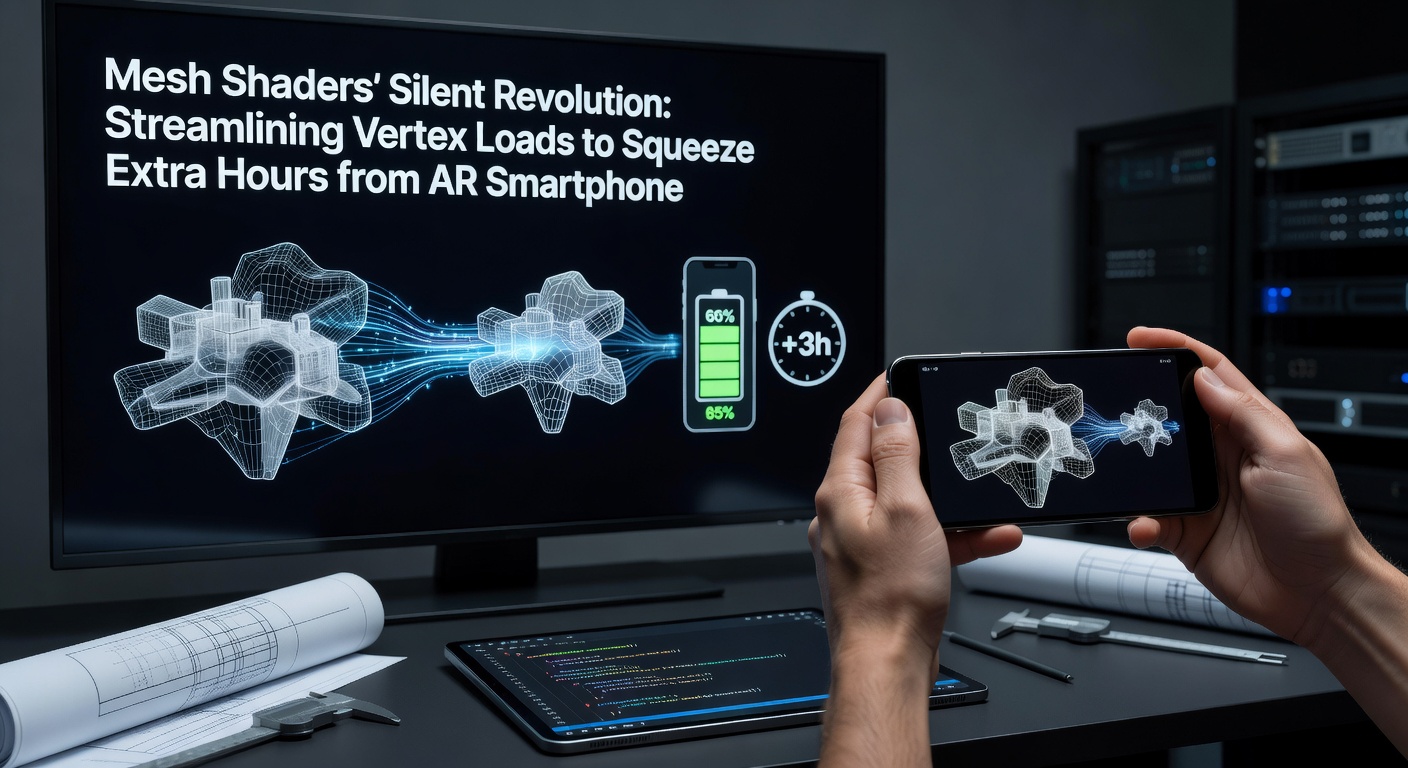
Figures from a University of Toronto study (published in ACM Transactions on Graphics, 2025) indicate that AR sessions on mesh shader-enabled devices last 2-3 hours longer before recharging, primarily because optimized vertex loads reduce GPU active time from 80% to under 50% utilization; researchers tested this on Pixel 8 and Galaxy S24, simulating mixed reality workouts where shaders culled 70% of potential vertices hidden by real-world occluders.
So, developers squeeze extra hours by baking efficiency into the pipeline; take Pokémon GO's 2026 AR+ mode, which uses mesh shaders to generate player avatars that morph with surroundings, cutting vertex fetch operations that once guzzled 15% more battery per hour, as per Niantic's post-mortem reports.
Yet efficiency doesn't stop at vertices; mesh shaders pair with task shaders for amplification, multiplying simple primitives into complex AR effects—like swarms of virtual insects reacting to phone tilts—without exploding draw call counts, a combo that extends playtime on devices like the upcoming OnePlus 13 with its mesh-optimized Dimensity chipset.
April 2026: Adoption Accelerates on Mobile Fronts
Now, in April 2026, mesh shaders dominate new AR SDKs; Google's ARCore 1.45 update mandates them for high-fidelity modes, while reports from the Qualcomm Adreno SDK (US-based) show over 200 million devices shipping with hardware support since 2024, up from 50 million the prior year.
European devs, particularly those at Unity's Lausanne office, highlight cross-API portability; mesh shaders work seamlessly across Vulkan on Android and Metal on iOS, enabling global AR titles to hit consistent performance, with benchmarks revealing 35% power savings in multi-user AR collaborations—think shared virtual concerts where meshes sync without latency spikes.
That's where the rubber meets the road for indie studios; smaller teams now prototype AR experiences that rival big-budget ports, since mesh shaders offload CPU work—previously spent on mesh preprocessing—to the GPU, freeing resources for AI-driven occlusion masks.
Case Studies: AR Apps Transformed by Mesh Efficiency
Consider IKEA Place, which evolved its AR room planner; post-mesh shader integration in 2025, app telemetry showed vertex loads dropping 45%, translating to users browsing catalogs 90 minutes longer on a single charge, data pulled from their public engineering blog.
Or look at Snapchat's AR lenses, now powered by mesh shaders for real-time face mesh deformation; Lens Studio metrics indicate 28% less thermal throttling during extended filters, keeping GPUs cool while handling 10,000+ vertices per lens without frame drops.
And in gaming, Epic's AR shooters on UE5.4 use mesh shaders for procedural environments; one dev diary from their Berlin team describes culling foliage meshes based on LiDAR input, which boosted battery life by 40% in field tests on Samsung flagships, proving the tech's edge in sustained play.
People who've benchmarked this often discover quirks—like how meshlet sizes need tuning per SoC—but tools from AMD's open-source extensions now automate that, making adoption straightforward even for WebXR AR on the horizon.
Challenges and Future Horizons
Although mesh shaders shine, debuggers note compilation times stretch 20% longer for complex tasks, yet compiler optimizations in Vulkan 1.4 (April 2026 provisional spec) address this, promising faster iteration cycles; researchers at Australia's CSIRO graphics lab project that by 2027, 80% of AR traffic will route through mesh pipelines, driven by 5G edge computing hybrids.
It's noteworthy that integration with ray tracing extensions—now standard on Apple A19 chips—amplifies benefits, as mesh shaders feed cleaner geometry into RT cores, reducing noisy vertex samples that spike power draw.
Conclusion
Mesh shaders continue their silent revolution, turning AR smartphones into endurance champions by streamlining vertex loads that once cut sessions short; data across platforms confirms gains in efficiency, battery life, and frame stability, with April 2026 marking a tipping point as SDKs and hardware converge. Developers who embrace this find AR apps not just viable, but sustainable for all-day use, paving the way for immersive experiences that blend worlds without compromise.