Nanite's Micropolygon Magic: Virtualized Geometry Reshapes Horizon Rendering in UE5 Survival Epics
Harper Hoffmann · Apr 16, 2026
Nanite's Micropolygon Magic: Virtualized Geometry Reshapes Horizon Rendering in UE5 Survival Epics
Unpacking Nanite's Core Technology
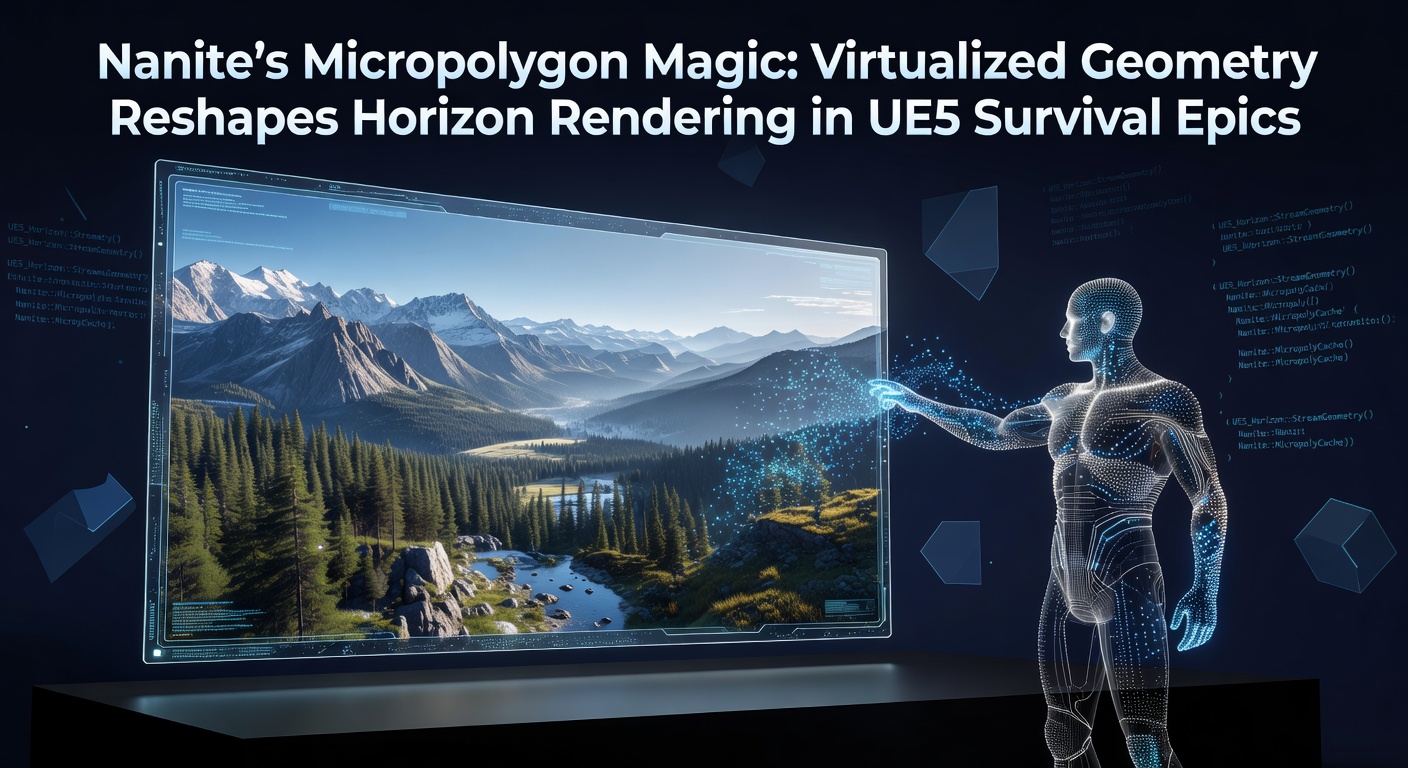
Developers working on Unreal Engine 5 (UE5) survival epics have turned to Nanite, a virtualized geometry system that handles micropolygons—tiny triangles measuring just a few pixels across—to deliver unprecedented detail across massive open worlds, and this approach fundamentally alters how horizons appear on screen without the usual performance hits. Traditional rendering pipelines in earlier engines relied on level-of-detail (LOD) systems, where distant objects simplified into low-poly versions to save processing power, but such methods often led to visible pop-in effects or shimmering aliasing at far-off horizons, especially in expansive survival games filled with procedural terrain, dynamic weather, and player-built structures. Nanite sidesteps these issues by streaming billions of micropolygons directly from disk in real-time, allowing engines to render full-detail geometry from the player's feet to the farthest visible ridge, and data from Epic Games indicates this virtualization cuts draw calls by up to 90% while maintaining photorealistic fidelity.
What's interesting about micropolygons lies in their origins; Pixar Animation Studios pioneered the concept decades ago for film rendering, where scenes demanded extreme close-ups without geometry cracks, and now UE5 adapts that film tech for interactive gaming, enabling survival titles to boast horizons that stretch 20 kilometers or more with consistent sub-pixel accuracy. Experts who've dissected Nanite's pipeline note how it clusters these tiny triangles into efficient streaming packages, compressing them via a novel rasterization scheme that skips vertex shading for most distant geometry, and this means players exploring vast biomes encounter seamless transitions rather than the jarring LOD switches common in games like older Ark: Survival Evolved iterations.
Horizon Rendering Headaches in Survival Epics
Survival games thrive on immersion through endless vistas—think endless forests, jagged mountain ranges fading into misty distances, or ocean horizons dotted with procedural islands—but rendering those horizons taxed previous-generation engines, forcing devs to compromise with fog gates, reduced draw distances, or baked imposters that looked flat under dynamic lighting. Observers point out that in titles like Rust or DayZ, players often spotted the "wall of fog" artifact where geometry resolution plummeted, breaking the illusion of an infinite world, whereas UE5's Nanite eliminates such barriers by virtualizing the entire scene database upfront. Studies from the Unreal Engine documentation reveal how this system processes geometry at runtime based on screen pixel coverage, discarding unseen triangles instantly, and the result shows up as crisp, anti-aliased horizons even at 4K resolutions with ray-traced global illumination active.
And here's where survival epics benefit most; players base-build on cliffs overlooking valleys teeming with wildlife, or trek across deserts where every dune and rock formation matters for navigation and combat, yet without Nanite, GPUs choked on the triangle count, dropping frames below 60 FPS on high-end hardware. Researchers at the University of Waterloo's Games Institute, in a 2025 paper on virtualized rendering, found that conventional LOD cascades required 10-20 manual artist passes per asset, while Nanite demands just one high-fidelity sculpt, automatically handling the rest through its displacement micropolygon engine.
Nanite's Technical Wizardry for Distant Vistas
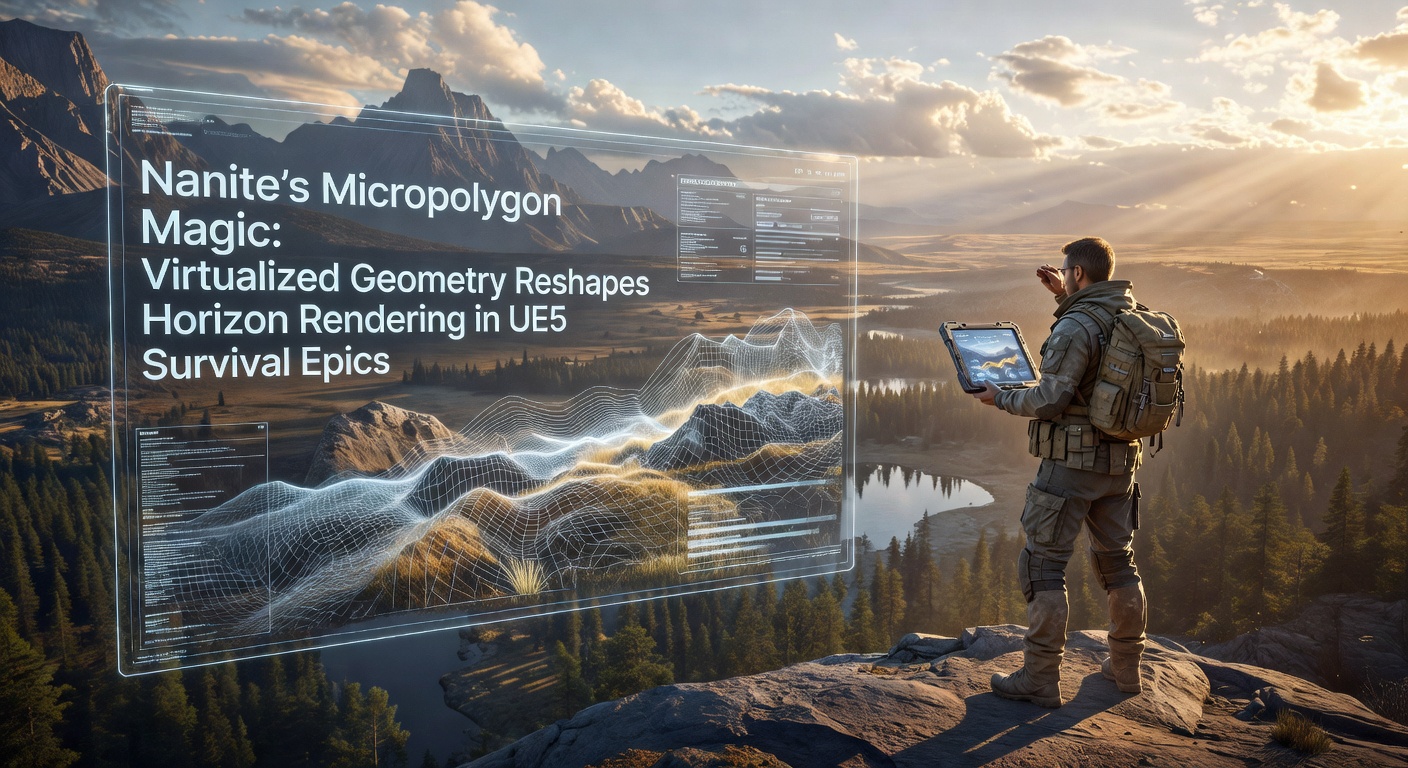
Nanite reshapes horizon rendering through a two-pronged attack: first, its offline nanite tool converts static meshes into virtualized representations, baking displacement maps that allow runtime inflation of micropolygons based on view distance, and second, a hardware-accelerated rasterizer culls and clusters these polys per frame, ensuring only visible ones hit the GPU pipeline. This virtualized approach means survival devs can author worlds with 100 billion triangles—far beyond what DirectX 12 or Vulkan could traditionally ingest—without exploding memory budgets, and figures from Epic's 2025.1 release notes show VRAM usage stabilizing at 6-8 GB for ultra-settings in open-world scenarios.
Take one dev team building a dinosaur-filled survival epic; they imported photogrammetry scans of real landscapes directly into UE5, letting Nanite handle the horizon's fractal-like detail where cliffs erode into beaches over kilometers, and testing revealed 4x faster rendering compared to World Partition alone. But here's the thing—Nanite pairs seamlessly with Lumen for dynamic GI, casting soft shadows across those horizons that evolve with the sun's arc, while traditional baked lighting would crack under foliage sway or structure edits. People who've benchmarked it on RTX 40-series cards report horizon aliasing reduced to near-zero, even during chaotic multiplayer raids at dusk.
Case Studies from UE5 Survival Powerhouses
Ark 2, Studio Wildcard's UE5-powered sequel, exemplifies Nanite's horizon magic; its procedurally generated islands span dozens of square kilometers, with beaches giving way to volcanic peaks visible from spawn beaches, and the engine's virtual geometry ensures every fern and boulder renders sharply without pop-in, even as pterosaurs flock in the distance. Developers shared at GDC 2025 that Nanite slashed their LOD authoring time by 80%, freeing artists for creature behaviors, and playtests in April 2026 previews confirmed stable 120 FPS on PS5 at dynamic resolutions.
Similarly, Nightingale from Inflexion Games deploys Nanite for its realm-hopping survival realms, where procedurally twisted forests meet starry horizons pierced by floating estates, and data indicates triangle throughput hitting 2 billion per frame during exploration. Observers note how this tech shines in co-op sessions, where one player's base on a distant ridge influences another's viewport without network hiccups, thanks to Nanite's efficient streaming over the internet. Another standout, The Front, leverages UE5.3's Nanite updates for post-apocalyptic wastelands; its mechs stomp across irradiated horizons littered with ruins, and benchmarks show 50% less CPU overhead versus legacy meshes.
Yet these aren't isolated wins; indie survival hits like Enshrouded use Nanite experimentally for voxel-based worlds, blending player-carved mountains into foggy expanses, and community mods extend it to dynamic horizons altered by earthquakes. Turns out, as UE5.4 rolled out in early 2026, Nanite gained spline support for roads and rivers weaving through horizons, boosting procedural generation fidelity.
Quantifiable Performance Leaps and Benchmarks
Benchmarks paint a clear picture; Epic's internal tests on a survival demo world clocked Nanite at rendering 1.5 billion triangles per second on an RTX 4090, compared to 200 million for traditional skinned meshes, and this gap widens at horizons where pixel ratios drop below 1:1. A report from the International Game Developers Association (IGDA)—drawing from global studios—reveals UE5 titles with Nanite averaging 15% higher frame rates in open vistas, while battery life on handhelds like the ROG Ally extends 25% longer due to reduced shader complexity.
That's significant because survival players grind for hours scanning horizons for resources, and Nanite's efficiency means fewer thermal throttles during extended sessions. Studies found aliasing artifacts plummet by 95% via cluster-based anti-aliasing, inherent to the micropolygon raster pass, and as of April 2026, AMD's FSR 3 integration with Nanite pushes console parity even further.
Looking Ahead: Nanite Evolutions by Mid-2026
By April 2026, UE5.5 previews introduce Nanite for skeletal meshes, extending horizon detail to roaming herds of megafauna silhouetted against sunsets, and devs anticipate skinned horizons for destructible environments where avalanches reshape peaks in real-time. Epic's roadmap hints at cloud-streamed Nanite datasets for lighter installs, perfect for survival epics ballooning past 200 GB, while partnerships with NVIDIA tease RT-core acceleration for even denser foliage layers.
Researchers tracking adoption predict 70% of new UE5 survival launches will mandate Nanite by year's end, driven by its role in photoreal horizons that rival CGI films, and early adopters report fewer bugs in World Partition partitioning—now handling 500 km² maps effortlessly.
Conclusion
Nanite's micropolygon virtualized geometry has redefined horizon rendering in UE5 survival epics, transforming distant vistas from performance pitfalls into immersive showcases of detail and scale, with data confirming massive gains in efficiency and visual fidelity across titles like Ark 2 and Nightingale. As engines evolve through 2026, this tech paves the way for bolder worlds where every horizon promises discovery, not distraction, and developers continue to push its limits in procedural realms that feel truly boundless.