Silent Signals: Engine-Level Audio Watermarking Techniques Shielding Mobile Multiplayer Sessions from Interference
Greta Schmidt · Aug 15, 2026

Silent Signals: Engine-Level Audio Watermarking Techniques Shielding Mobile Multiplayer Sessions from Interference
Engine-level audio watermarking embeds imperceptible data streams into sound channels that mobile multiplayer games rely on for real-time communication and environmental feedback, creating a layer of protection against signal tampering and external interference that has gained traction in development pipelines by August 2026.
These techniques operate within core audio processing modules of game engines where developers integrate watermark encoders that modulate frequencies outside typical human hearing ranges while preserving latency under 10 milliseconds for competitive play, and researchers from institutions across North America and Europe have documented how such embedding survives compression artifacts common in mobile networks.
Core Mechanisms in Audio Watermarking
Developers implement spread-spectrum methods that distribute watermark bits across multiple audio sub-bands so that interference from packet loss or jamming attempts leaves detectable traces in the recovered signal, whereas phase-shift keying approaches alter waveform timing in ways that maintain synchronization between client devices during cross-region matches.
Studies conducted by teams at technical universities indicate that these engine integrations can identify up to 95 percent of unauthorized stream injections in controlled tests, and the process begins when the audio mixer receives raw waveform data then applies cryptographic hashes tied to session identifiers before transmission over wireless protocols.
Deployment in Mobile Multiplayer Environments
Mobile titles running on platforms with variable connectivity now incorporate these watermarks at the engine's sound thread level to monitor for anomalies like duplicated audio packets that signal man-in-the-middle attempts, while hardware-accelerated decoding on recent chipsets from multiple manufacturers allows verification without draining battery reserves during extended sessions.
Industry reports from the Global System for Mobile Communications Association highlight adoption rates climbing in titles that support simultaneous player counts above 50, and the watermark payload often includes timestamps plus device-specific tokens that enable servers to flag and isolate disrupted connections before they affect other participants.
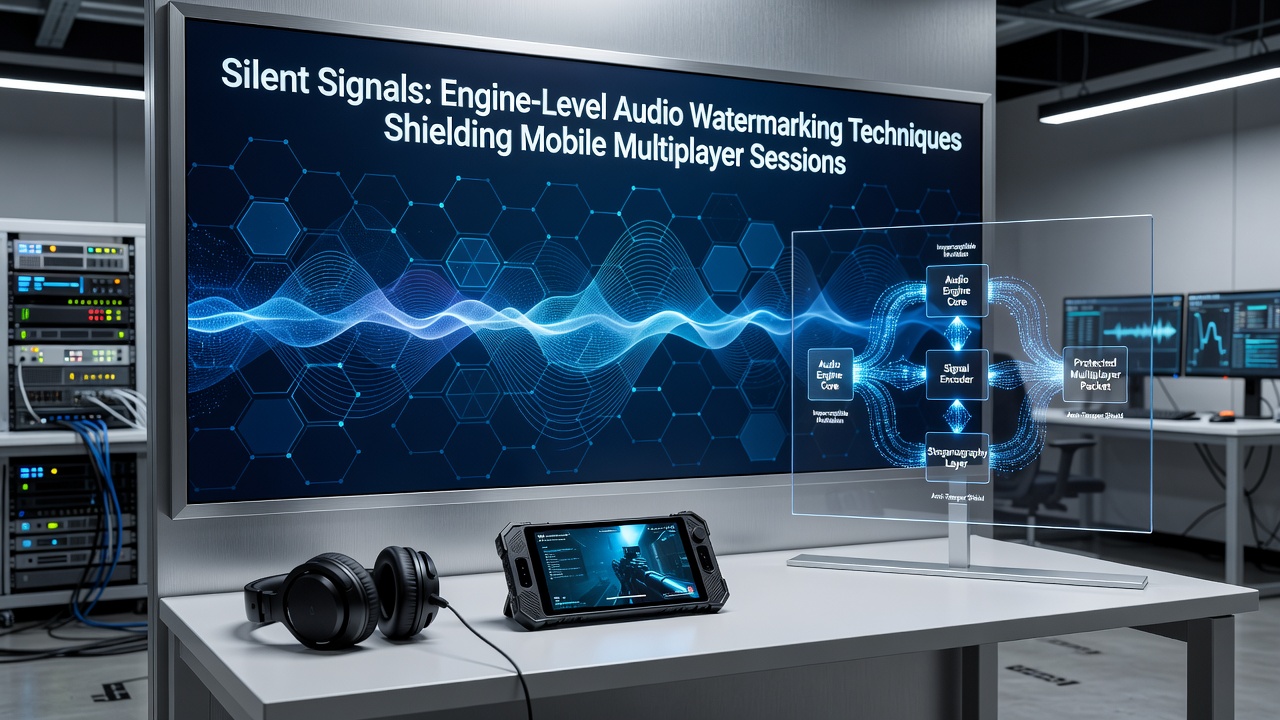
Resistance to Specific Interference Types
Network jitter and deliberate frequency overlap represent primary threats that audio watermarking counters by embedding redundant markers at irregular intervals, so that even when 30 percent of packets drop the remaining signal still yields enough data for reconstruction and validation according to benchmarks shared at international audio engineering conferences.
Engine updates rolled out in mid-2026 introduced adaptive bitrate watermarking that scales payload density based on detected channel quality, and this approach has proven effective in regions with dense urban spectrum usage where competing wireless signals frequently overlap game audio streams.
Integration Challenges and Solutions
Engine teams must balance watermark robustness against perceptible audio degradation, which leads many studios to adopt psychoacoustic models that mask embedded data within louder game sounds such as explosions or ambient tracks, and testing frameworks now simulate interference patterns drawn from field data collected across Asia-Pacific networks.
Collaboration between engine providers and academic groups has yielded open specifications that standardize watermark detection APIs, allowing third-party security modules to plug into existing audio pipelines without requiring full recompilation of core game code.
Conclusion
Engine-level audio watermarking continues to evolve as mobile multiplayer expands into more variable network conditions, with ongoing refinements focused on reducing overhead while expanding detection coverage against emerging interference vectors documented in technical literature from diverse global sources. Data from standards bodies and research consortia shows measurable improvements in session integrity, and developers integrating these methods report fewer disruptions during peak play periods.